Airport phone charging: 250,000 users at Marseille Airport
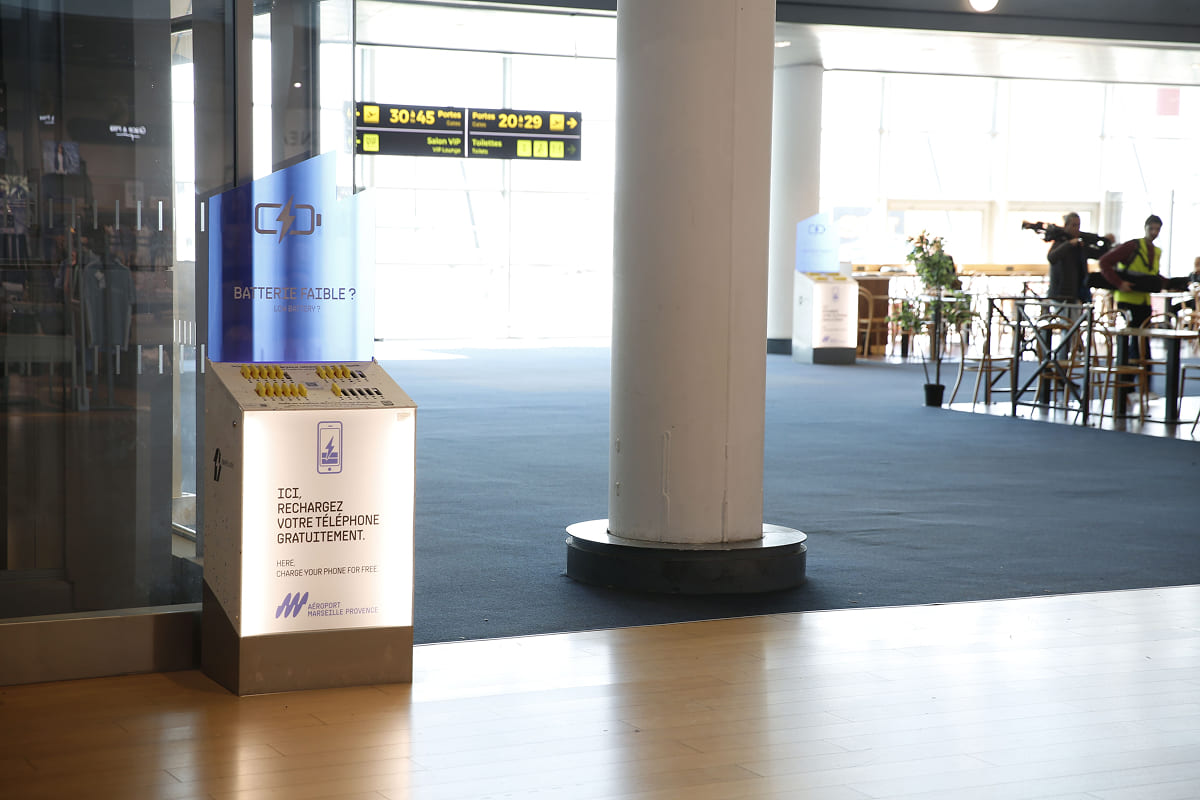
Almost a year after the service was deployed, Marseille Provence Airport has already recorded more than 250,000 uses of the OneFlash stations, with a satisfaction score of 4.8 out of 5 and clearly changed buying behaviour in the duty free area. These figures confirm what many operators suspected without being able to quantify it precisely: mobile charging in airports is no longer an ancillary comfort service, but a genuine lever for passenger experience and commercial performance. A look back at a collaboration that shows concretely how a well-integrated charging station transforms both the traveller journey and the business of the shops in the boarding area.
Mobile charging, a service that has become critical in airports
Digital boarding pass, real-time flight information, contactless payment, keeping in touch with loved ones, navigating airport apps, entertainment while waiting: at every stage of the journey, the passenger's phone is in demand. A battery that dies at the moment of boarding is no longer a simple inconvenience, it immediately undermines the smoothness of the traveller journey. As Guillaume Espoune, business manager CFA at AMP, sums it up, “it has become crucial to have battery on your phone for all the steps, from check-in to boarding”.
For an airport platform, meeting this need is therefore no longer a nicety: it is a concrete way of supporting the passenger experience across the whole site, with a service whose value travellers understand immediately. This is precisely the ground on which the French start-up OneFlash, now the European leader in self-service mobile charging, has built its positioning.
How the OneFlash service actually works at Marseille Provence
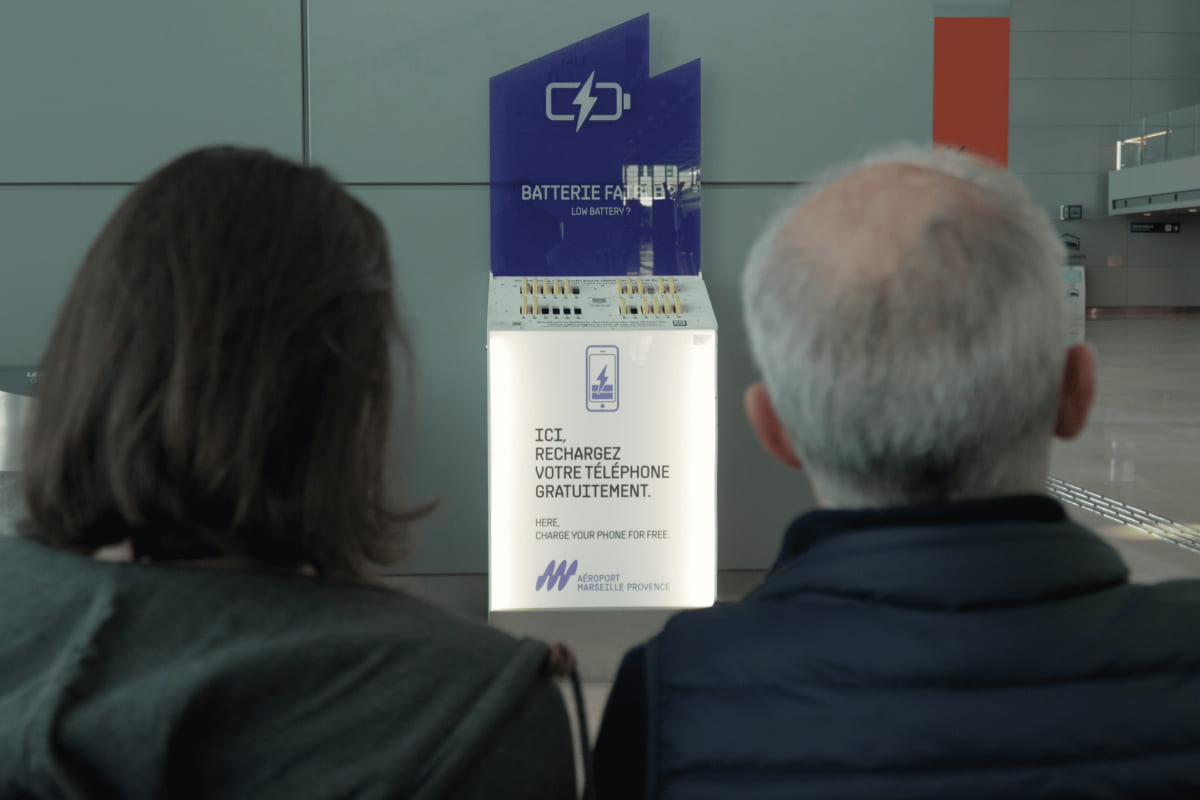
The experience offered to passengers rests on an extremely simple mechanism. All it takes is to scan a QR code on the station, borrow a power bank fitted with the main cables compatible with the smartphones on the market, then return it to one of the 30 stations spread across the airport's two terminals. This network logic lets travellers move freely between the check-in, security, shopping and boarding areas without being tied to a power socket. Where a wall socket forces a passive wait of thirty to sixty minutes, the OneFlash station leaves passengers free to move while their phone charges in their pocket or bag.
Multi-device compatibility is another decisive advantage. The power banks include USB Type-C, Lightning and micro USB connectors at the same time, covering all the smartphones and accessories used by passengers, whether a recent iPhone, a Samsung Galaxy or an older Android model. No visitor is left facing a service they cannot use, which is essential in an environment as diverse as an international airport.
Results that exceed initial expectations
The figures collected in under a year of operation speak for themselves. The Marseille platform records more than 15,000 uses per month, which represents nearly 500 loans a day across the whole site. Longer stays in the duty free area, measured since the service was deployed, reflect a real change in traveller behaviour: freed from the constraint of the wall socket, they spend more time exploring the shops and discovering the retail offer available before boarding.
The satisfaction score of 4.8 out of 5 also confirms the perceived quality of the experience. With an audience as demanding and rushed as that of an international airport, reaching this level of rating requires near-flawless reliability, real availability of power banks across the whole fleet, and perfectly smooth integration into the passenger journey. It is precisely the combination of these three factors that sets mature solutions apart from those still in an operational learning phase.
An impact that can also be measured on the commercial side
Freeing the passenger mechanically translates into higher footfall in the shops and services on site. On the ground, the observation is shared by the retailers themselves. “I've noticed that a lot of passengers were using it, it helps increase the turnover of the shops and the airport”, explains Jean-Pierre Mandaci, a shop assistant at Aelia Duty Free. This qualitative observation matches the economic logic of the service: a passenger whose battery is reassured extends their time in the commercial area, makes an impulse purchase more readily and makes more use of the paid services available on the platform.
For an airport, this dimension changes how return on investment is read. The charging station stops being a simple cost item or an isolated comfort service and becomes a genuine contributor to the turnover of the concessions and commercial partners on the site. This virtuous logic explains the growing interest of major mobility players in this type of equipment.
Frictionless operations for ground teams
Beyond the experience offered to passengers, the quality of a mobile charging service is also measured by how easily it can be operated day to day. The OneFlash offer was designed to fit into high-traffic environments, with several levels of customisation available depending on the operator's needs. Deployment, follow-up, maintenance and user after-sales support are entirely handled by the OneFlash teams, which considerably lightens the operational load on the teams in place.
The effectiveness of this turnkey approach shows in unforeseen situations. As illustrated by a recent anecdote told by Guillaume Espoune: “at the beginning of March, a luggage trolley completely destroyed a station, and we replaced it within the hour! Thanks to the stock we hold nearby.” This response time, particularly short in a complex airport environment, relies on a logistics set-up designed in advance, with a stock of power banks and stations positioned as close as possible to the site to absorb incidents without any loss of service. It is this operational discipline, invisible to the passenger but decisive for the operator, that guarantees the real availability of the service month after month.
A model already proven by major mobility players
With more than 2,000 active stations in Europe, OneFlash relies on a network sized to operate at scale. The model has already been proven by several leading players in the mobility sector, including SNCF, RATP, the airports of Amsterdam and Rotterdam, and now Marseille Provence Airport. This body of references illustrates OneFlash's ability to meet the specific demands of major transit hubs, where service reliability, infrastructure robustness and user experience quality leave no room for approximation.
For airport management teams evaluating this type of solution, this is a valuable benchmark. Deploying a mobile charging service in an environment as demanding as an airport terminal requires an operational maturity that no recent offer can seriously claim. Issues of electrical safety, flow management, integration with existing systems and continuity of service in the event of an incident demand know-how that cannot be improvised.
Mobile charging, a lasting lever for passenger experience
The experience at Marseille Provence Airport shows that mobile charging has definitively left the realm of peripheral services to join the structuring levers of the passenger experience. With 250,000 users, 15,000 uses a month and 4.8 out of 5 satisfaction, the system deployed by OneFlash meets a need that has become central and at the same time makes a measurable contribution to the turnover of the concessions on site.
For operators of airports, stations, shopping centres or any other high-footfall venue, the Marseille feedback is a useful benchmark. It shows that a well-designed service, run by a partner able to maintain quality over time, transforms how a place is perceived, extends time spent on site and lastingly supports commercial activity. In a context where customer experience has become the main loyalty factor, building a reliable charging station into the visitor journey is no longer an option to study but an investment to schedule.
To equip your venue as early as tomorrow, book a meeting with our experts!