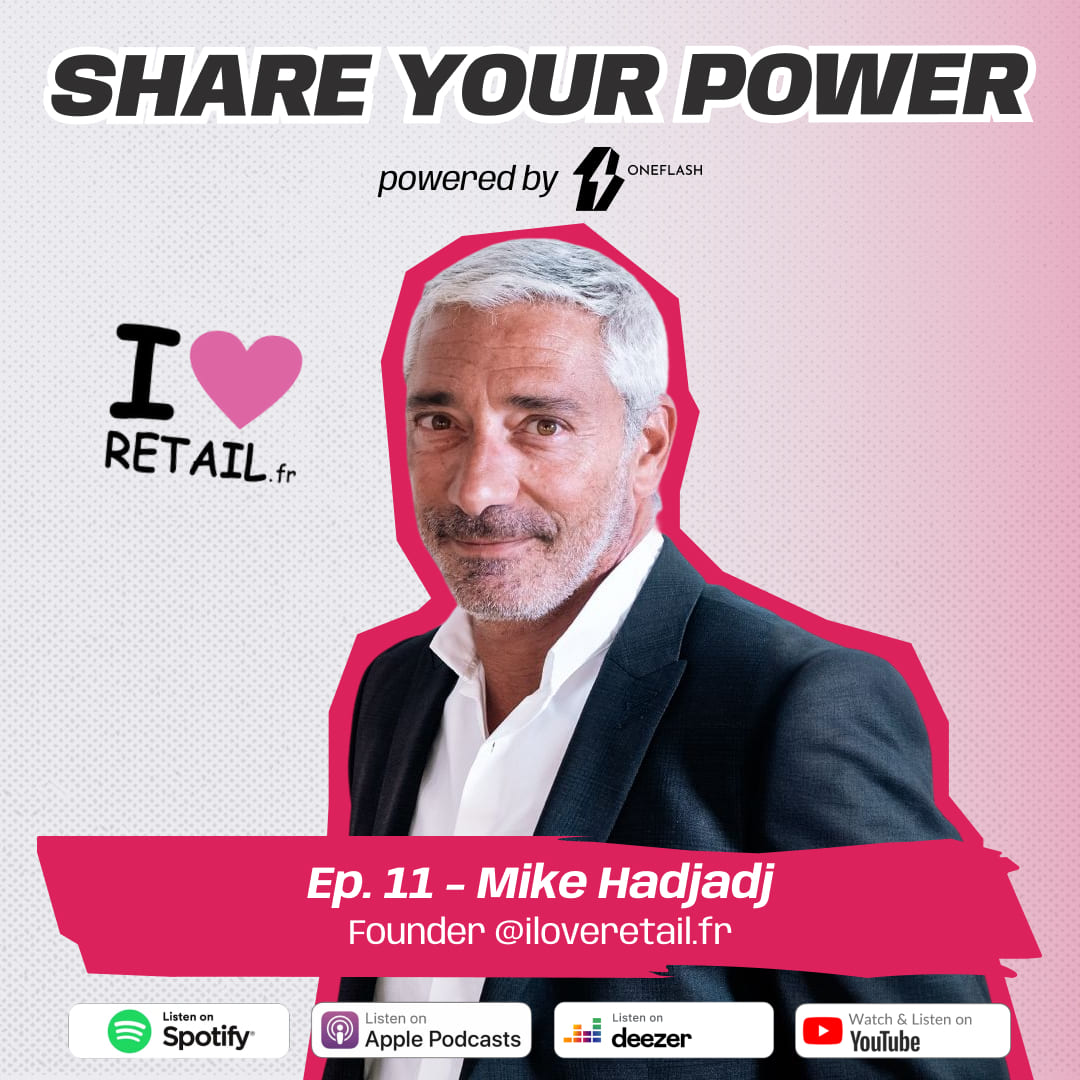
Mike Hadjadj (La Retail Tech): Share Your Power - Episode 11
Founder of iloveretail.fr and co-initiator of La Retail Tech, a network that now brings together more than 210 retailers, Mike Hadjadj has observed physical retail for 25 years. National ambassador of the “Osez l'IA” (Dare to use AI) programme for retail, he shares in this episode an unfiltered view of artificial intelligence, the consumer paradox and what, in the in-store customer experience, will never change.

How does a sector that was declared dead with the arrival of e-commerce keep reinventing the customer experience twenty-five years later? In this eleventh episode of Share Your Power, the podcast powered by OneFlash, Lucas Di Franco welcomes Mike Hadjadj, founder of iloveretail.fr, co-initiator of the La Retail Tech network and national ambassador of the “Osez l'IA” (Dare to use AI) programme for retail. A dense conversation about physical retail, its constants and its disruptions.
The consumer paradox
Drawing on twenty-five years of consumer research, Mike Hadjadj makes a blunt observation: what customers say in a CSR survey and what they do with their bank card in hand are two different things. The explosion of Shein and Temu is the starkest illustration. Behind this contradiction lies a steadier conviction: the need to be supported, listened to and valued by a brand has not changed in twenty years. What changes is how you respond to it, not the attention a retailer must pay to its customer.
The "Chinese slap": less a question of tech than of model
One of the most striking passages of the conversation concerns what Mike Hadjadj calls the "Chinese slap": in the big Asian retailers, data, payment, CRM and e-commerce are pooled with two or three major technology players. As a result, consumers constantly benefit from the latest innovations, without every retailer having to reinvent its own infrastructure. In France, each retailer builds its own technology silos, each with its own teams, costs and slow start, a fragmentation that holds back innovation and ultimately slows the improvement of the in-store experience.
Agentic commerce, three levels of disruption
The heart of the conversation concerns the arrival of agentic commerce, which Mike Hadjadj breaks down into three layers. The first level, already visible, is conversational agents built into retailers' sites, Hopla at Carrefour, Elo at Castorama, which replace the classic search engine with a natural-language dialogue through to adding to the basket. The second level, more disruptive, is the new AI-driven browsers (Atlas, Comet) that browse and buy on the customer's behalf on a site that did not need to build anything for it. The third level, still emerging but already dizzying: buying directly from a mainstream LLM, without ever visiting the brand's site. For retailers who have invested tens of millions in their e-commerce experience and SEO, the question becomes existential: how do you stay visible and chosen when the customer no longer clicks a link, but delegates their decision to an agent?
Small retail, the forgotten... and a great opportunity
As ambassador of the national “Osez l'IA” programme, Mike Hadjadj devotes part of his time to very small businesses and independent shopkeepers, often at a loss in the face of these changes. His conviction: generative AI democratises uses that were previously reserved for big retailers, automatically enriched product pages, professional visuals generated in a few clicks, a web presence accessible without technical skills. The issue is no longer the size of the budget, but the ability to get started and test, one small solution after another.
Smart video surveillance, sizing and shared data
The conversation also sweeps through more operational topics that reveal international gaps: smart video surveillance for detecting fraudulent behaviour, only recently regulated in France while already widely deployed across the Atlantic; AI-driven size recommendations at players such as Zalando to reduce the return rate in fashion; and the near-total absence of data sharing between retailers in France, which prevents smooth uses such as frictionless unlocking of a bike, a scooter or a power bank.
The physical store, a place that cannot be fully automated
Despite this technological acceleration, Mike Hadjadj's most clear-cut conviction remains this: the 100% automated store has no future. Tomorrow's retail will remain a phygital mix, where technology augments people without replacing them, and where attention to the customer on the shop floor remains the real differentiator between two retailers who, deep down, sell comparable products.
What this conversation says about the in-store experience
What this episode reveals between the lines is how much the in-store customer experience now comes down to organisational details as much as to AI strategy. A point of sale that invests in the welcome, the fluidity of the journey and visitor comfort builds a loyalty that neither a conversational agent nor an AI browser can ever recreate remotely.
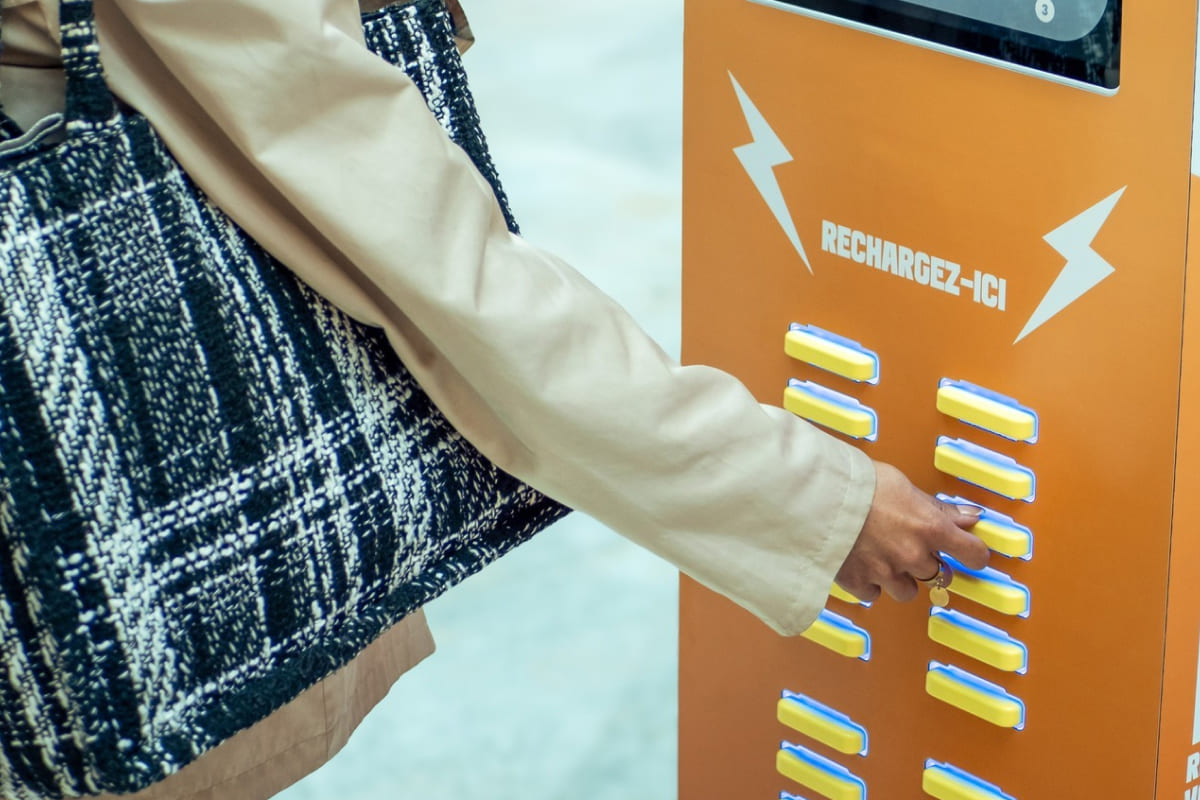
It is precisely in this logic that OneFlash fits. A self-service mobile charging station installed in a store, in a shopping centre mall or at a retailer's welcome desk meets a very concrete need: keeping the customer available, present and relaxed during their visit, rather than worried about their phone's battery level. In a shop where every friction point counts, whether queueing, looking for a power socket or breaking the shopping journey, a phone charging station accessible in a few seconds becomes a simple service that improves the phygital experience offered by the retailer, without ever replacing the human attention that Mike Hadjadj places at the centre of his vision of retail.
In summary
This conversation with Mike Hadjadj sketches a retail sector both shaken up by agentic commerce and faithful to its fundamentals: listening to the customer, attention to the shop floor, and a service that remains, against all the machines, a matter of people. In this equation, looking after every detail of the in-store journey, including the visitor's digital comfort, remains one of the simplest and most effective levers for standing out.
Hear the full conversation between Lucas Di Franco and Mike Hadjadj by listening to episode 11 of Share Your Power.
Découvrez tout nos autres articles :
Self-service power banks: phone charging for bars and nightclubs
Standalone power bank station: phone charging at the restaurant
Customer loyalty in restaurants: bring guests back with phone charging
Customer knowledge: how to collect the right data
Marketing activation: turning every interaction into an engagement lever for your brand
.jpeg)
Phone lockers: the limits and the modern alternative
Charging stations in conference centres: equipping an event

Charging stations in theme parks: improving the visitor experience all day long
CSR approach: the mobile charging station, a concrete lever for businesses welcoming the public
Grégory Sion (Pierre & Vacances): Share Your Power - Episode 14
Sébastien Manceau (European Camping Group): Share Your Power - Episode 13
Mobile charging: every way to charge your phone easily
Dominique Thillaud (Compagnie des Alpes): Share Your Power - Episode 12
.jpeg)
Charging stations: the complete guide to choosing
%2520(1).jpeg)
USB fast charging: the complete guide
Antoine de Tavernost (Auditoire): Share Your Power - Episode 10
Charging station rental: the complete guide
Power banks for mobile devices: the complete guide
Phone charging in public places: wall sockets
Ask Jamy! How does a power bank work?
In-store customer experience tools: the levers to activate

Are portable power banks dangerous?
The best power bank station services